Why a Multi-Vendor Strategy Makes the Difference in Modern IT Infrastructure
Auteur: ServerDirect
March 6, 2026
Infrastructure forms the foundation of almost every digital organization—from media and education to automotive and AI workloads. Yet, the choice of servers, storage, and networking is often still heavily influenced by a single supplier or an existing vendor relationship. While this might seem logical for the sake of convenience and simplicity, it also limits the space to build a solution that truly fits the organization's needs.
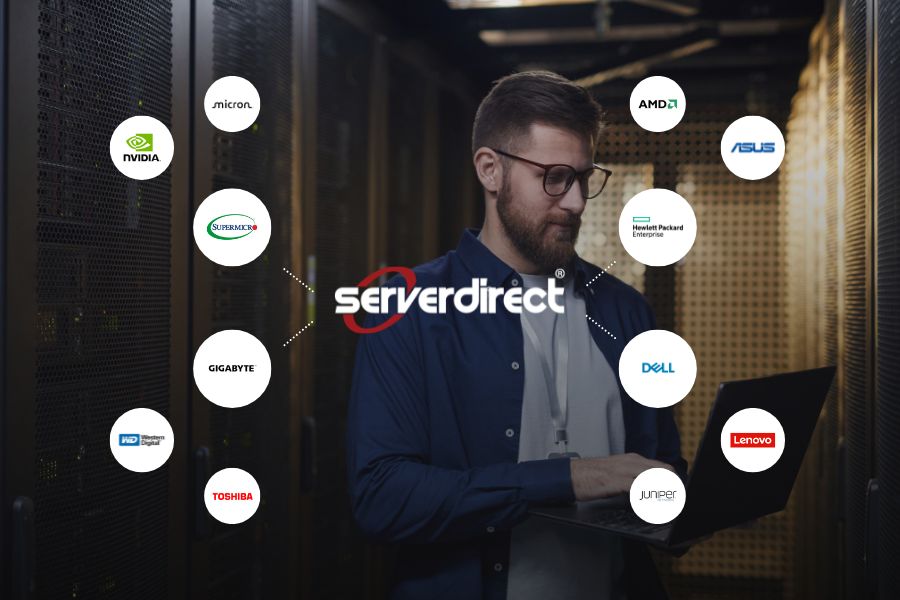
At ServerDirect, we intentionally maintain a multi-vendor strategy. This means we work with various renowned manufacturers such as Supermicro, Dell Technologies, Hewlett Packard Enterprise, and Gigabyte. This offers the freedom to design infrastructure based on what an organization actually needs. That independence forms the core of a multi-vendor approach.
The infrastructure request starts with the customer's needs
Every infrastructure request begins with the same first step: understanding what an organization is trying to achieve. What kind of workloads are running? How will the environment evolve over the coming years? Where are the primary performance or scalability requirements?
An organization running data-intensive AI workloads has different requirements for servers and storage than a data center or a finance platform with thousands of users. Networking also plays an increasingly important role here. The way compute, storage, and network work together ultimately determines the performance of the entire environment.
In a single-vendor model, the solution is often built around the portfolio of one manufacturer. In a multi-vendor strategy, the process is reversed. First, the architecture is determined. Then, it is determined which technology best fits that design. That sequence makes a fundamental difference.
Architecture-driven choices instead of product-driven choices
One of the biggest advantages of a multi-vendor strategy is that infrastructure can be designed based on architecture rather than product catalogs. ServerDirect looks at the big picture first. Which combination of compute, networking, and storage delivers the best balance between performance, scalability, and manageability? Then, the manufacturer or technology that best aligns with that design is selected.
In some environments, this means a server architecture based on Supermicro. In other cases, a Dell environment is a better fit. For specific HPC or AI configurations, Gigabyte can be a strong choice, while HPE offers an optimal solution in certain enterprise scenarios. This freedom results in an infrastructure that is actually tailored to the workload and not to a pre-selected vendor.
Flexibility and future-proofing
Infrastructure must not only function today but also move with future developments. This is especially true in an era where technology develops rapidly and workloads become increasingly complex. A multi-vendor strategy prevents dependency on a single manufacturer. This allows an organization to remain flexible when new technologies become available or when specific parts of the infrastructure need to be expanded.
It also provides room to combine components based on their strengths. Networking, compute, and storage do not necessarily have to come from the same supplier to work together perfectly. On the contrary, the best infrastructures often arise precisely from a combination of technologies that each excel in their own field. For organizations, this means more control over their technological roadmap.
The role of multi-vendor strategy in AI infrastructure
AI infrastructure perhaps shows most clearly why a multi-vendor strategy is valuable. AI workloads differ enormously from one another. Training, inferencing, data processing, and edge applications all place different demands on hardware and architecture. Some AI environments require GPU-optimized server architectures. Other workloads run more efficiently on CPU-based clusters. In still other cases, the challenge lies mainly in storage bandwidth or network capacity.
By working with multiple manufacturers, ServerDirect can design a suitable infrastructure for every AI use case. This could be a GPU cluster, an HPC environment, or a scalable storage architecture for data processing. The technology is chosen based on the workload, not based on vendor preference. Especially in AI environments, where performance and scalability are crucial, that makes a big difference.
Independent advice as a starting point at ServerDirect
For customers, a multi-vendor strategy means one thing above all: independent advice. The infrastructure is designed based on content, expertise, and experience. ServerDirect works daily with various technology platforms and manufacturers. This creates a broad perspective on what works in practice and what turns out to be less scalable in the long term. The result is an infrastructure that fits the organization, the workload, and the ambitions for the future.
Building infrastructure from substance
A multi-vendor strategy requires technical depth and architectural knowledge. It means that engineers master multiple technologies and can design solutions from the drawing board. At ServerDirect, that is exactly the basis of the approach. Based on a combination of architectural thinking, vendor independence, and more than 15 years of experience in research, enterprise, and AI environments, infrastructures are designed that continue to function sustainably. Not because one manufacturer dictates it, but because the solution was built from the start around the customer's needs.
A strategy that puts the customer first
Ultimately, a multi-vendor strategy is about one starting point: the customer comes first. By looking independently at servers, networking, and storage, room is created for a solution that is technically sound, remains scalable, and grows with future developments. Architecture, performance, and scalability form the starting point. That is where a multi-vendor strategy proves its value. And that is exactly why organizations choose ServerDirect as a partner for their infrastructure.
Do you want to explore how a multi-vendor strategy can work within your organization? Our architects are happy to brainstorm with you. In a no-obligation consultation, we will look together at your current infrastructure, future workloads, and the architecture that fits best.


Schrijf in voor onze Nieuwsbrief
Hebt u vragen of hulp nodig? Wij helpen u graag.
Leverancier van betrouwbare serveroplossingen en opslag. Systeemintegratie van servers en opslag van fabrikanten zoals Supermicro, ASUS, NetApp, HPE, Dell, GIGABYTE, ASRock, Western Digital, Seagate, Micron, Chenbro, Toshiba. Wij leveren wereldwijd: Brussel, Parijs, Madrid, Rome, Amerika, Dubai en meer.