AMD’s next leap: Zen 6 and the future of CPUs
Auteur: Siu-Ho
November 13, 2025
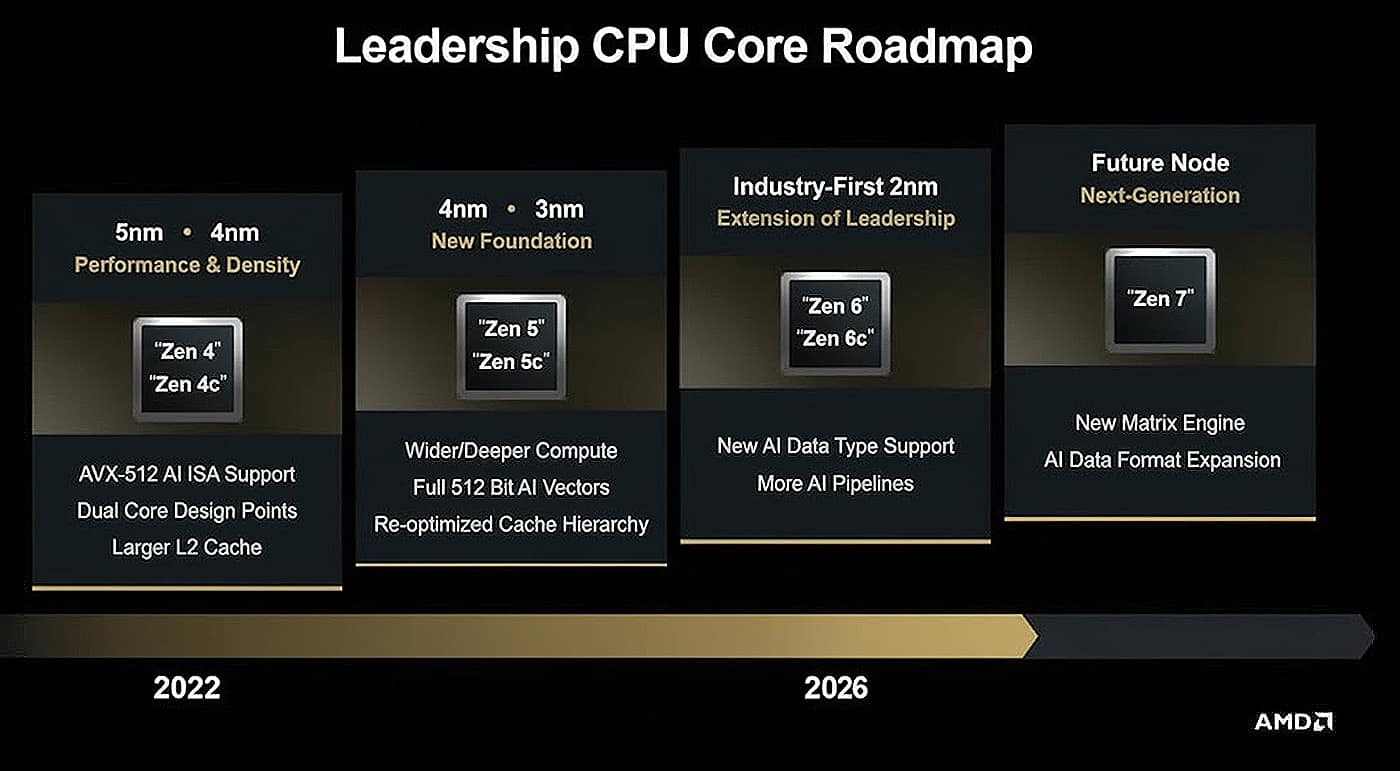
AMD has released an updated CPU roadmap that outlines the path toward Zen 6 and offers the first hints of Zen 7. The announcement highlights major architectural shifts, a move to next-generation manufacturing nodes, and expanded AI-focused capabilities. Below is a structured overview of what is known so far, why these developments matter, and what to watch as Zen 6 approaches launch.
Overview of the roadmap
Key points confirmed
- Zen 6 is targeting a 2026 launch window.
- The architecture is expected to be built on TSMC’s 2 nm (N2) process node, marking a significant density and efficiency improvement.
- Two variants are planned:
- Zen 6: performance-focused
- Zen 6c: high-density, power-efficient
- AI-related instruction sets will expand, including AVX512 FP16 and AVX VNNI INT8 support.
- Zen 7 appears on the roadmap as the next step afterward, accompanied by references to a new matrix engine and broader AI capabilities.
Sources include reporting from several different sources.
Technical highlights
2 nm TSMC Process
The shift toward 2 nm is among the largest leaps AMD has attempted in recent years.
Benefits include:
- Increased transistor density
- Lower power per transistor
- Potential for higher core counts or improved frequencies
Expanded AI Instructions
Zen 6 integrates support for newer, AI-optimized data formats and operations. This reflects a broader industry trend where CPUs complement GPUs and NPUs in AI-assisted workloads.
AM5 Platform outlook
AMD has indicated continued support for the AM5 socket, which increases the likelihood that Zen 6 will be compatible with existing AM5 motherboards. This extends upgrade flexibility for current AM5 users.
Server-oriented scaling
Early information hints that Zen 6c may be designed for very high core counts and large cache configurations, especially in EPYC server products.
Why Zen 6 matters
For desktop systems
- The move to 2 nm is expected to deliver performance-per-watt improvements.
- Higher-efficiency cores and expanded AI instruction support position Zen 6 for both traditional workloads and emerging AI-driven applications.
For content creation and development
- AVX512 FP16 and AI-optimized operations can accelerate media processing, code compilation, and tasks that rely on vectorized operations.
- Zen 6’s architectural refinements may provide smoother performance in multithreaded workflows.
For server and datacenter environments
- High-density Zen 6c variants could offer improved compute-per-rack and performance scaling.
- Larger caches and efficient core clustering have the potential to enhance throughput in virtualization, container workloads, and cloud compute applications.
Software support for next-generation AI instructions will also be an important factor. Hardware acceleration is only effective if applications actively adopt the new data formats and pipelines.
Looking ahead
Zen 6 marks a major architectural transition. With the shift to 2 nm, expanded AI capabilities, and continued AM5 platform support, AMD is positioning its next generation to meet both current performance expectations and future AI-assisted workloads. As more details emerge throughout the development cycle, the picture of Zen 6’s real-world impact will continue to sharpen.


Schrijf in voor onze Nieuwsbrief
Hebt u vragen of hulp nodig? Wij helpen u graag.
Leverancier van betrouwbare serveroplossingen en opslag. Systeemintegratie van servers en opslag van fabrikanten zoals Supermicro, ASUS, NetApp, HPE, Dell, GIGABYTE, ASRock, Western Digital, Seagate, Micron, Chenbro, Toshiba. Wij leveren wereldwijd: Brussel, Parijs, Madrid, Rome, Amerika, Dubai en meer.